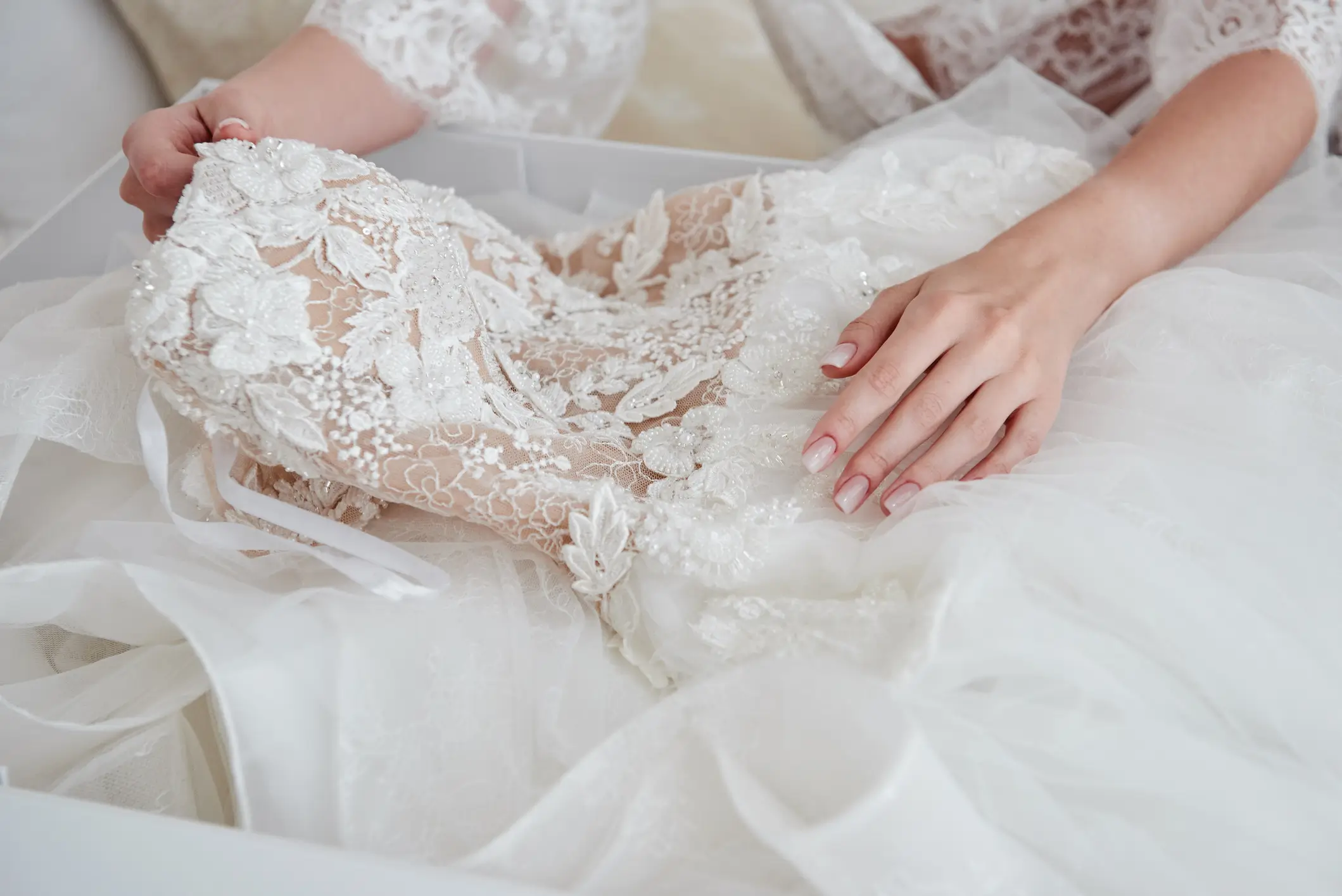
Wedding dress preservation is still on your list; it just hasn't happened yet, and that dress has been sitting untouched since the big day, waiting on a decision you haven't made. What matters right now is that you have a simple, zero-cost temporary solution and you can put it together in under an hour with items already around your house.
It buys real time, weeks and a few months, but the clock is still running underneath it all. This guide covers that plan in full, then tells you plainly when it stops being safe to wait.
If your dress is still in the bag in which it came home, that's the first thing to fix, and it matters more than anything else in this guide. That bag was never meant for storage. It's transport packaging, built to get a dress from the shop or the cleaner to your car without it dragging on the ground.
Sealed plastic traps moisture against the fabric, and some plastic films release compounds over time that speed up yellowing. A dress left zipped in that bag for six months is worse off than one simply hanging in an open closet with nothing covering it at all.
Unzip it. Take it out. Let it hang free while you read the rest of this.
Garment bags marketed as breathable still trap more than people expect. A woven cotton or muslin bag allows airflow because the weave itself has gaps. A garment bag with a zipper and a lining, even one labeled breathable, is often just thinner plastic with a fabric layer stitched over it. Check the inside. If it feels slick or plasticky to the touch, treat it the same as the original transport bag.
Your wedding day involved hours of movement, body heat, humidity, and probably a spilled drink or two. Most dresses go straight from that into a bag while still faintly damp, and that's how a storage plan quietly turns into a mildew problem.
Hang the dress in a dry, ventilated room away from direct sunlight for a full day, ideally two. A spare bedroom or a hallway works fine. You're not trying to dry out a stain here, just letting any trapped humidity leave the fabric before it's sealed away with nowhere to go.
If any of these are true, give it another day before moving to the next step.
This is the one instruction in this entire guide that costs nothing and matters the most, and almost nobody does it.
Right now, you remember what spilled and roughly where. You remember the champagne toast, the hem that dragged through the parking lot, the makeup mark near the zipper. In six months, you won't. And a cleaner working on a stain months later, with no idea what caused it or how old it is, is working blind. Knowing if a mark is champagne, foundation, or grass changes the treatment entirely.
Take five minutes now:
This single step will do more for the eventual outcome than anything else in this guide, whenever you get around to it.
Stains aren't the only thing worth recording. Note any place the fabric snagged, any beading that came loose, and any seam that felt strained by the end of the night. A cleaner or preservation specialist working from a full picture, not just the visible spots, can flag structural issues before they get worse in storage.
It's tempting once you can see the marks clearly. Don't.
Water alone can leave a permanent ring on silk. Household stain removers can set a mark permanently or pull color out of the dye. Once a stain has been treated badly at home, it's often harder to remove than it was originally, because now there are two problems layered on top of each other instead of one.
Leave every mark exactly as it is. Your notes from the last section are doing the work here instead.
If something is actively wet right now, fresh red wine, for instance, blotting gently with a plain white cloth to lift excess liquid is fine. Blot, don't rub, and stop there. Anything beyond lifting excess moisture belongs to a professional.
How to store a wedding dress at home genuinely comes down to the actual method below, using things you likely already have.
What you'll need:
Steps:
Where not to put it:
Where to put it instead: an interior closet on the main floor of the house. Off the floor, away from exterior walls, and away from any heating or cooling vent.
Exterior walls and vents both create temperature swings, and temperature swings cause condensation inside whatever the dress is wrapped in, even a breathable cotton sheet. An interior closet stays closer to a stable room temperature year-round, which is the real goal. You're not looking for cold or dry specifically. You're looking for stability.
Most storage advice skips this nuance, but it depends entirely on the dress. A light, unembellished dress can hang on a wide, padded hanger for a short interim period; it breathes and avoids extra folds. A heavier dress with beading, a long train, or a structured bodice, should be laid flat instead. The weight pulls on the shoulder seams and bodice from day one, and that stress adds up fast.
Lift the dress with one hand at the shoulder. If it feels light and moves easily, hanging for a few weeks is fine. If it feels heavy, or you can feel the weight pulling as soon as you lift it, lay it flat instead.
Everything above buys you real time, not unlimited time. Leftover sugar from champagne, skin oils, and other invisible residues keep reacting with the fabric even after the dress looks clean. Weeks are fine. A few months carry some risk. Years are usually when the marks, often yellowing, start to show.
Pick a date, put it in your calendar, and treat it as your decision day. A consultation costs nothing and usually answers the real question behind the delay, the cost of actual wedding dress preservation.
You did the hard part – getting the dress out of the plastic, wrapped correctly, and safely tucked away. The only thing left is picking a day to find out what it actually needs, before that invisible clock catches up with you.
At Cavalier Cleaners, we've offered professional wedding dress cleaning and preservation across Northeast Ohio for generations, and we know exactly what a few months in storage can and can't wait out. We inspect every stitch, treat every stain by hand, and pack your dress in a sealed, acid-free preservation chest built to protect it for decades.
You can stop by or call us if you're looking for bridal dress preservation near the Brunswick area; we'll examine your dress and tell you straight up what it needs and how much it costs.
Address: 1413 Pearl Rd., Brunswick, OH
Phone: (330) 952-7569
Email: Ashley@myCavalier.com
Schedule Pickup: mycavalier.smrtapp.com